Introduction
Your septic tank quietly handles hundreds of gallons of waste every day, and most Washington homeowners don’t think about it until raw sewage backs up into their shower. The issue is that most people don’t realize there’s a real difference between having their tank pumped and having it properly cleaned, and that knowledge gap is precisely what results in drainfield failures, structural tank damage, and repair bills that could have been avoided altogether. At Dano’s Septic, we’ve spent 30 years watching preventable problems become expensive emergencies, and this blog exists to make sure that doesn’t happen to you.
Here, we break down septic pumping vs. cleaning, what each service actually does inside your tank, the difference between septic pumping and cleaning, and how to know which one your system needs right now.
How a Septic Tank Actually Works
Most homeowners picture their septic tank as a simple holding container. In fact, it’s a biological processing system, and realizing that changes everything about how you maintain it.
Wastewater from your home enters the tank and separates into three distinct layers:
- Scum: Fats and oils float to the top
- Effluent: Relatively clarified liquid sits in the middle and exits to the drainfield
- Sludge: Heavy solids compact at the bottom
The tank depends on this separation to function. When septic tank sludge removal is delayed too long, the bottom layer grows thick enough to push solids into the effluent zone, and from there, directly into your drainfield. A clogged drainfield isn’t just a matter of pumping. It may require a complete overhaul.
What Is Septic Pumping?
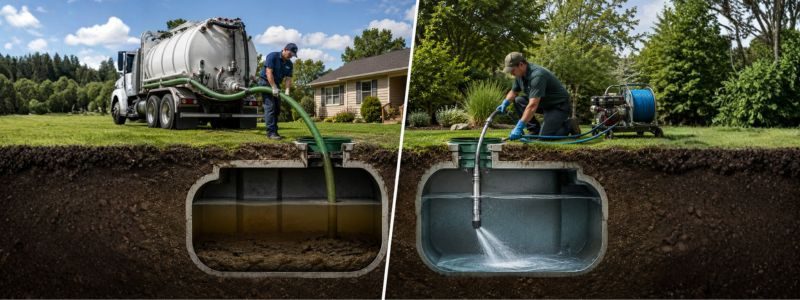
Septic tank pumping is the standard service most homeowners schedule, and it’s genuinely important. A vacuum truck suctions out the liquid waste, floating scum, and most of the accumulated solids from your tank. Then the technician visually inspects the baffles and tank structure before closing the lid.
What pumping doesn’t always do: fully remove the dense, compacted sludge layer at the very bottom of the tank. Depending on how long it’s been since the last servicing, that layer can be thick enough that a single pass of the vacuum won’t clear it completely.
The Washington State Health Department recommends septic tank pumping every 3 to 5 years. But that’s a baseline; household size, water usage, and tank capacity all affect how often to pump a septic tank for your specific home.
What Is Septic Cleaning?
Septic tank cleaning is the more thorough version of the same process, and the difference matters more than most homeowners realize.
After vacuuming out the tank, a full cleaning includes a high-pressure water rinse of the tank interior, targeted removal of compacted bottom sludge, baffle cleaning, and a detailed inspection of the inlet and outlet components. It’s the difference between emptying a trash can and actually washing it out.
This level of service is what you need when:
- Your tank hasn’t been serviced in five or more years
- A septic tank inspection and service report has flagged excessive buildup
- You’re already noticing signs you need septic cleaning, like slow drains or odors near the yard
Industry Fact Worth Knowing: When the sludge layer comes within 12 inches of the outlet baffle, or floating solids come within 3 inches of it, your tank isn’t just “due for service.” It’s at active risk of pushing solids into your drainfield. At that point, pumping alone may not be enough.
Key Differences: Pumping vs. Cleaning
Understanding the difference between septic pumping and cleaning comes down to depth of service, not just effort.
| Service Feature | Pumping | Cleaning |
| Liquid & scum removal | Yes | Yes |
| Partial sludge removal | Yes | Yes |
| Full compacted sludge removal | Partial | Complete |
| Interior tank rinse | No | Yes |
| Baffle & component inspection | Basic | Thorough |
| Best for | Routine maintenance | Neglected or heavily loaded tanks |
How to Tell Which Service You Really Need
Your Tank Is Telling You Something: Are You Listening?
If you are on a regular service schedule and your system is symptom-free, then routine pumping is the way to go. But some signs are pretty clear for a full septic tank cleaning:
- Drains are slowing down across multiple fixtures simultaneously
- Gurgling sounds when flushing or running water
- Wet patches or unusually green grass over the drainfield
- Foul odors outside near the tank or absorption area
- It’s been longer than five years since any service
If more than one of these applies to your home in Shelton, Bremerton, or Port Orchard right now, don’t schedule a routine pump and hope for the best. Get the tank inspected first so the tech can determine the actual sludge depth and then recommend a service level.
The Role of Professional Inspection
Washington State now requires periodic O&M inspections for all on-site septic systems. A certified inspection gives you an objective measurement of sludge and scum depths, baffle condition, and drainfield health, the data you actually need to make the right call on septic service cost and frequency for your home.
How to Talk to Your Septic Service Provider
Most homeowners call and simply ask for a pump. A better conversation sounds like this:
- “Can you measure my sludge depth before recommending a service level?”
- “Will the service include an interior rinse, or just vacuuming?”
- “Can I get a written report on the condition of my baffles and tank?”
A good provider will not hesitate to answer all three of these. If they can’t tell you what the difference is between what they are offering and a full cleaning, that’s your answer.
The real cost of skipping service isn’t the pump you delayed. It’s the drainfield you’ll have to replace.
Simple Maintenance Tips to Stretch Time Between Services
Good septic system maintenance isn’t complicated, but it does require consistency.
Protect your tank between service visits:
- Never flush wipes, medications, grease, or chemical cleaners, even products labeled “flushable”
- Limit garbage disposal use, as it sends excess solids into the tank faster than most people expect
- Don’t plant trees or large shrubs within 30 feet of the drainfield
- Never park vehicles or run heavy equipment over the absorption area
- Keep records of every pump, inspection, and cleaning with the date and technician notes
Water conservation also directly impacts how often to pump a septic tank. Too much water flow pushes solids through the tank before they have a chance to settle out properly, overloading the drainfield with material it can’t handle.
The Bottom Line on Septic Pumping vs. Cleaning
Every septic system eventually needs both services, but not always at the same time, and not always in the way most homeowners assume. Septic tank pumping handles routine buildup and keeps your system running on schedule. Septic tank cleaning goes deeper, removing the compacted material that a vacuum pass alone won’t fully clear. Knowing the difference between septic pumping and cleaning is what separates proactive homeowners from those calling for emergency service on a Saturday night.
Dano’s Septic has been providing residential and commercial septic tank inspection and service, pumping, and maintenance across Shelton, Bremerton, Port Orchard, and throughout Washington for over 30 years. Our licensed inspectors provide full written reports after every visit, so you always know exactly what condition your system is in and what it needs next. Every new residential install we complete is now backed by a 10-year limited warranty, as long as regular maintenance stays current.
Don’t wait for your system to tell you it’s failing. Call Dano’s Septic at (360) 697-1271, we answer 24 hours a day, 7 days a week, including weekends and holidays. One call and a Dano’s family member will walk you through exactly what your system needs.