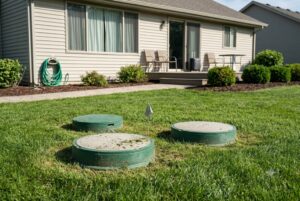
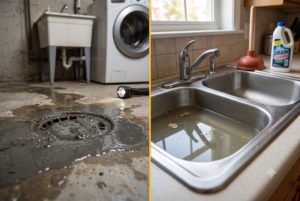
Most septic systems don’t fail because a part breaks. They fail because of something unseen that has been going on for years underground, quietly, while everything above ground still looks normal. Often by the time a homeowner sees standing water in the yard or hears the toilet gurgle, the damage below has been building for a decade. That’s the part most people don’t learn until it costs them a drainfield replacement, not a standard cleaning. At Dano’s Septic, we’ve spent 30 years watching this exact pattern play out, and we’d rather explain it to homeowners before it happens than fix it after.
This blog is deeper than the normal “pump every few years” advice. We’ll explain what’s really happening inside a septic tank between services, why the drainfield fails the way it does, and how to read the warning signs your system is giving you before a backup forces the issue. You’ll also see what really drives septic tank cost and how local inspection data should change the way you think about maintenance.
Why Septic Maintenance Is Especially Important in Bremerton
Soil here isn’t forgiving. Much of the ground around Bremerton is dense, glacially compacted till that drains slower than sandy soil in other parts of the state, meaning a septic system here has far less margin for error once solids start escaping the tank. In this kind of ground, a system that can handle a missed cycle of pumping in looser soil can begin backing up a lot sooner.
The local numbers back this up. Kitsap Public Health District’s own data on its inspections of conveyances indicate that over a quarter of septic systems inspected during recent property sales in the county had significant deficiencies, deficiencies that in most cases had been building for years before anyone noticed. That statistic alone should change the way homeowners here think about septic tank maintenance because it implies neglect is common enough to be practically the default outcome without deliberate upkeep.
Signs Your Septic Tank Needs Pumping
Before we get to the list every homeowner anticipates, it helps to know what’s really happening inside the tank when these symptoms arise because it explains how and why waiting just a few extra months can matter.
What’s Actually Happening Below the Surface
Septic tanks separate waste into three layers. At the bottom, solids settle, while grease and oils form a scum layer at the top, allowing the liquid effluent in the middle to flow to the drainfield. Most tanks have only about 4 inches of clearance between the inlet and outlet pipes. Once solids get high enough to span that gap, the tank no longer properly separates waste and starts pushing solids directly into the drainfield. This clogs the soil instead of the tank.
The Symptoms Homeowners Actually Notice
- Drains running slower throughout the house, not just at one fixture.
- Gurgling from toilets or drains right after flushing.
- Standing water or unusually soggy ground over the drainfield.
- A sulfur or sewage smell lingering outside near the tank or field.
- Patches of grass over the drainfield that are noticeably greener or spongier than the rest of the yard.
Once solids reach the drainfield, pumping the tank won’t undo the damage. Only time, and sometimes a full field replacement, can.
How Often Should You Pump Your Septic Tank?
Health officials generally recommend pumping every three to five years. The range is based on tank size, household habits, and daily water use, all of which push the real number in different directions for different homes.
The Measurement Inspectors Actually Use
Rather than guessing by the calendar, licensed technicians measure two things directly: the distance between the floating scum layer and the outlet baffle, and the distance between the settled sludge and that same baffle. Once the scum layer closes to within three inches of the baffle, or the sludge rises to within twelve inches of it, the tank needs pumping regardless of how long it’s been since the last service.
What Shortens the Interval
| Situation | Effect |
| Garbage disposal used regularly | Adds solids the tank must break down, shortening the interval |
| Household of five or more | Increases both water volume and solid waste |
| Undersized tank for the home | Fills faster no matter how careful the household is |
| Heavy laundry or long showers | Pushes more liquid through the system daily |
What Happens During a Professional Pumping Service
A pumping appointment is actually two services in one: the removal of any accumulated waste, and an inspection that catches problems while they are still cheap to fix.
- The technician locates and opens the tank’s access lid.
- A vacuum truck removes the sludge, scum, and liquid contents.
- The tank walls are flushed to clear remaining residue.
- The technician inspects the baffles, walls, and lid for cracks or root intrusion.
- The lid is closed, and the access point is reburied.
Septic Maintenance Tips Between Pumpings
A thin biological layer, called biomat, naturally builds up around the drainfield over time and is actually a good thing, as it filters out pathogens before wastewater reaches the soil. The trouble begins when that layer becomes too thick for effluent to get through it as fast as the household is making wastewater.
Why Overloading the System Speeds This Up
Each extra gallon of water and each little bit of grease or solid waste that goes down the drain feeds the bacteria that build that layer. If you push it too fast and too hard, the biomat will thicken faster than the underlying soil can absorb it, causing the wastewater to either pool on the surface or push back up into the house.
- Spread laundry loads across the week instead of running several back to back.
- Never flush wipes, grease, or medications, even ones marketed as flushable.
- Limit garbage disposal use, since it adds solids the tank has to process.
- Keep vehicles and heavy equipment off the drainfield entirely.
- Keep trees and deep-rooted shrubs at least 30 feet from the field.
Choosing a Septic Service Provider in Bremerton
Homeowners across Bremerton, Silverdale, Port Orchard, and Shelton are best served by a provider who understands this region’s soil and its health district’s requirements firsthand, not a crew unfamiliar with local conditions. At Dano’s Septic, our team has spent three decades working on residential and commercial systems throughout the area, and we answer calls 24 hours a day, seven days a week, because a backup rarely waits for business hours. Alongside septic pumping, we offer certified septic inspection services, drainfield rejuvenation, riser installation, and repair work for homeowners who want a provider they can rely on for the life of their system.
What Your Septic System Is Really Telling You
A neglected septic system doesn’t fail all at once. It fails gradually, through a biomat layer that thickens past the point of no return, solids that migrate where they were never meant to go, and warning signs that get dismissed until a backup makes them impossible to ignore. Understanding what is really happening beneath the surface is what distinguishes homeowners who catch problems early from those who end up replacing an entire drainfield.
We built Dano’s Septic to give homeowners that understanding, not just a pumping truck. Whether you need a routine cleaning, a certified inspection to catch problems early, or emergency help after hours, our family-owned team treats every visit as a chance to protect a system you can’t easily see and shouldn’t have to worry about.
If it’s been a few years since your last service, don’t wait for the yard to tell you first. Call Dano’s Septic today at (360) 697-1271 to schedule your service.